



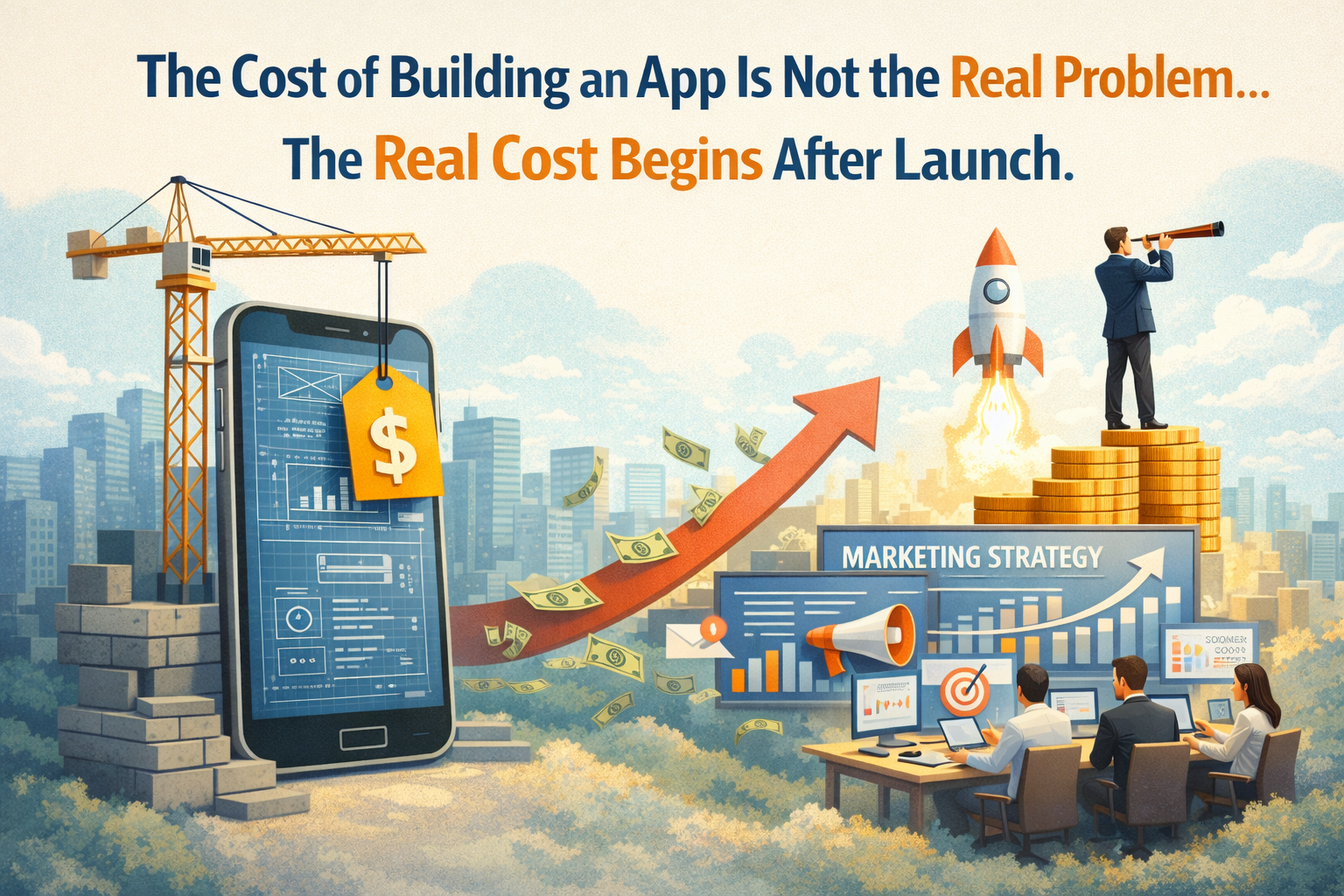
The Real Cost Begins After Launch
Whenever a business owner, investor, or decision-maker starts thinking about building an app or developing a digital platform , the first question is usually:
How much does it cost to build the app?
or
What is the cost of developing a professional app?
That is a reasonable question, but in many cases, it is not the right one.
The truth that many people overlook is that the cost of app development is usually not the biggest challenge in a digital project. The real cost of an app begins after development is complete—specifically during the stages of operations, marketing, customer acquisition, support, and continuous improvement .
Put simply:
building the app is not the end of the journey. It is only the beginning.
Why development cost is only part of the picture
Many clients focus on the price of designing an app or the cost of app development as if that alone determines the project’s success. But practical experience in the market shows otherwise. Many apps are developed with excellent technical quality, yet fail to generate real traction or returns.
Was the problem in the code?
Usually not.
The problem is that some people treat the app as the final product, while in reality, the app is just one tool within a much larger ecosystem that includes:
marketing
operations
sales
customer service
user experience
continuous improvement
and growth strategy
That is why the real question is not simply:
How much does it cost to build an app?
but rather:
How much does it cost to operate the app and turn it into a successful business?
The real cost of an app: what comes after development
1) The cost of app marketing
No matter how good the app is, it will not produce meaningful results without a clear marketing strategy . This is one of the most important truths in the world of app development and digital entrepreneurship :
An app that does not reach its target audience remains nothing more than a technical product that has not been properly invested in.
App marketing cost is not limited to paid ads. It also includes:
building the brand and message
defining the target market
studying the audience
preparing marketing content
managing advertising campaigns
improving conversion rates
optimizing landing pages
building trust and credibility
tracking results and making improvements
In many projects, the cost of marketing the app is higher than the cost of building it , especially when the goal is real market penetration rather than a purely technical launch.
2) The cost of operating the app
Once development is complete, a more complex and more important phase begins: running the app .
This is the stage where many business owners realize that an app does not operate by itself, and that having a technically strong system does not automatically mean having a successful business.
App operating costs include:
managing day-to-day operations
customer service
technical support
handling complaints and issues
managing content, requests, or users
performance oversight
analytics and reporting
coordination across teams and departments
All of this is part of the real cost of operating apps and platforms , and it is often missing from the initial expectations of many clients.
3) The cost of customer acquisition
One of the most important factors in the success or failure of any digital project is customer acquisition cost .
You may succeed in building a professional app , but the more important question is:
how much will it cost to get a user to:
download the app
sign up
use it for the first time
come back
convert into a paying customer
and continue using it
This is where understanding customer acquisition cost for apps becomes critical, because it may be much higher than the development cost itself.
In some cases, the issue is not that the app is bad. The issue is that the growth and marketing model was not properly planned , or that the cost of reaching customers is higher than the revenue expected from them.
4) The cost of building a real operating team
Any successful app needs people to run it.
This is another cost that many overlook in the beginning: the cost of the operating team .
You may need:
a support specialist
an operations manager
a product manager
a marketing team
a content creator
a data analyst
a quality supervisor
or even operational and commercial partnerships
All of these elements are part of the real cost of a digital business , because the app alone does not create success unless there is a team capable of running, improving, and managing it effectively.
5) The cost of continuous improvement and development
In digital products, there is no such thing as “finished forever.”
After launch, the app enters an ongoing cycle of:
updates
improvements
bug fixes
new features
user experience enhancements
performance optimization
security upgrades
adapting to market changes
That is why post-launch app development cost is a core part of the project, not an unexpected expense.
If the client does not account for this from the beginning, they may later feel that the project has become “too expensive,” when in fact this is simply the natural lifecycle of any successful digital product .
6) The cost of operational failure is often higher than the cost of development
From experience, many projects do not struggle because of poor development. They struggle because of:
lack of an operating plan
weak marketing
poor market understanding
an unprepared team
an unclear revenue model
lack of follow-up and improvement
That is why the cost of app failure after launch can be much higher than the cost of building it in the first place.
Spending on development alone without a real plan for marketing and operations is like building a premium store on a street where no one passes by.
The difference between buying an app and building a business
There is a major difference between a client who simply wants to build an app and one who wants to build a successful digital business .
The first focuses on:
price
delivery time
number of screens
features
The second focuses on:
the market
operations
customer acquisition
revenue model
scalability
sustainability
user journey
and performance indicators
This is where the real distinction appears between narrow technical thinking and proper strategic, investment-minded thinking.
As an entrepreneur or business owner, what is the right question to ask?
Instead of asking only:
How much does it cost to build an app?
It is better to ask:
What will it cost to operate the app after launch?
What is the app’s marketing strategy?
What is the cost of acquiring each customer?
What team is needed to run it?
What budget is required for growth?
What is the post-launch development and improvement plan?
How will the app evolve from a technical product into a revenue-generating business?
These are the questions that put you on the right path.
From my experience
From my experience in digital transformation and in designing and developing platforms and applications , I can confidently say that the smart client is not the one who searches for the lowest development price. The smart client is the one who understands the full value of the digital project .
Some clients succeed even when their development cost is higher than others, because they also invest in:
the right marketing
structured operations
trust-building
customer support
and continuous improvement
Others fail despite having a good app, because they assumed that programming alone was enough to create success.
Conclusion
The cost of the app is not the real problem.
The real problem begins when the entire project is reduced to “the price of development” alone.
Because the real cost of building an app does not stop at development. It extends to:
marketing cost
operating cost
customer acquisition cost
continuous improvement cost
and the cost of building a business system capable of turning the app into a successful venture
So before asking about the cost of building an app, ask first about the cost of making the app successful.
Because an app can be developed within a defined timeline,
but succeeding in the market requires vision, operations, patience, and smart post-launch investment.




Leave a comment
Your email address will not be published. Required fields are marked *